What Is the Golden Age of Art and Literature
Tomas Luis de Victoria
O magnum mysterium (1572)
Domine ad adjuvandum me festina
Cristóbal de Morales
Puer natus est nobis (1543)
Missa Benedicta es caelorum regina (excerpts) (1544)
Antonio de Cabezon (Click here for our related "In love" article)
Pavana con su glosa
Fabordones del octavo tono
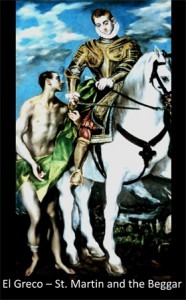
Extraordinary artistic achievements in music, fine art and literature created a "Golden Historic period" in Spain in the 16th and 17th centuries, paralleling the rise and decline of the Spanish Habsburgs' political ability and influence in Europe. Many of Kingdom of spain's most famous artists were in the utilise of the Royal court, the Spanish aristocracy and the church – their fame not only reaching beyond the borders of their own country in their own time, but condign important for European artists in the 19th and 20th centuries.

El Greco arrived from Crete via Italia and settled in Toledo, coming from a tradition of Greek orthodox icon painting, which explains to some extent his elongated figures, with small-scale heads and about two-dimensional forms. In St. Martin and the Beggar, we see a shift in perspective with the hind legs of the horse pushing towards the front legs. The elongated effigy of the beggar defies all of the rules of traditional Renaissance perspective, situated into the landscape of Toledo, where, as in many of El Greco's paintings, as many critics would point out afterwards, 'the sun never shines'.
This artificial light illuminates all of his portraits and landscapes. In the Apostle St. Bartholomew, we also detect El Greco'south loose treatment of the paint brush, which seems almost 'impressionistic'. It comes equally no surprise that his paintings, forgotten in the ensuing centuries, were rediscovered by painters of 19th century French republic, such as Delacroix and Manet.
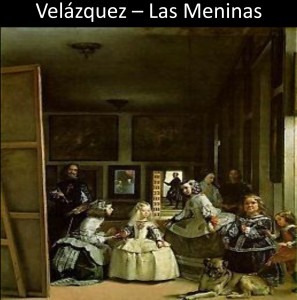
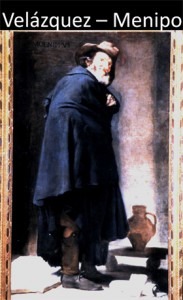
In his paintings Las Meninas, The Quondam Woman Frying Eggs and Menippus Diego Velázquez likewise raises the question of 'reality and illusion'. Regarding Las Meninas, the French writer Théophile Gautier asks the pertinent question: "Where is the painting"? Who is the real subject field of the painting? Velázquez, at his easel on the left, is looking out at us, the audience, and is at once the observer and creator of this perfectly composed scene. The handmaidens and the Infanta are in forepart of him, and the king and queen of Spain, reflected in the mirror backside him — all at an impossible angle to exist the subject of the painting, the actual subject remaining a true mystery. The light sources hither also come from different and contrary angles. As the poet Quevedo would observe, "There are many things here that seem to be and have their being, and yet they are nothing more a proper noun and appearance".
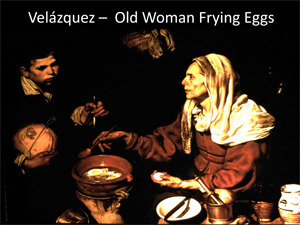
Velázquez' other paintings show Menippus, the Greek cynic and satirist, equally a beggar in an unusual pose, with a flat vase and diverse books at his feet, and the Old Woman Frying Eggs, in moments suspended in fourth dimension, — moments of arrested motion and persuasive silence.
Everything is simply and beautifully painted, lit from some outside source, creating precipitous shadows, but reducing subjects and objects to the aforementioned level of importance.
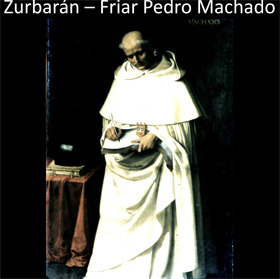
Francisco de Zurbarán, in his paintings of the Friar Machado and the Still-Life, raises the question of reality and imagination in another fashion. Zurbarán produced many paintings of monks, which inspired the following lines by Théophile Gautier:
"Moines de Zurbarán, blancs Chartreux/qui dans 50'ombre glissent silencieux sur les dalles des morts/murmurant des Paters et des Avés sans nombre…" (Zurbarán monks, white Carthusian habits/who, in the shadows glide silently over the stones of the dead/murmuring Our Fathers and Ave Marias without end…" Rather than focusing on the dissimilar characters of the monks, Zurbarán emphasizes the materiality of 'cloth' and the materiality of the beautifully painted objects in the still life — highly unusual for his time. Traditional still life paintings refer to the usual concepts of however-lifes every bit a reflection of the fragility of life, with reference to eternity. It therefore is no accident that Zurbarán was besides rediscovered in the 19th century past the Impressionists painters, with objects painted simply every bit objects, with no reference to eternity and the afterlife. Texture (taking Zurbarán's painting of monk's vestments, i.east. just 'cloth', equally an example) was created by the pigment itself.
Relating the art and literature of this time to its music, it is said that some of Espana'south greatest music was written in this period. Spanish composers of the time, including Tomás Luis de Victoria, Cabezón (please read our related "In love" article), Morales and many others, introduced many new forms of limerick, which would influence the music of the Baroque in Italy and other countries. The question of reality and illusion, presentation and silence carried into the performance of the famous Castrati singers at the Castilian court – leaving the meaning of their songs and estimation open and changeable from performance to operation. The importance of Kingdom of spain's 'Golden Age' in painting, literature and music carries on into the post-obit centuries, which will be the focus of our adjacent articles.
In literature, Miguel de Cervantes introduces a new and 'modern' form of writing in his 'Don Quixote', interspersing prose and poetry and his ain personal commentary and reflections. Specially in the novel's second function, Cervantes constantly intervenes with questions and comments on events mentioned previously. The illusions of the grapheme of Don Quixote himself and his author raise the bespeak of 'reality and truth' — similar to Velázquez, of whom Ortego y Gasset said: "I see in him a man who knew in the almost exemplary style how non to exist…" — which makes Don Quixote the first modern novel, every bit it was recognized by the writers of the 19th and 20th centuries.
lankfordthimed1993.blogspot.com
Source: https://interlude.hk/the-golden-age-of-spain-in-music-arts-and-literature/

Post a Comment for "What Is the Golden Age of Art and Literature"