I Need to Feel Something Again of Mice and Men
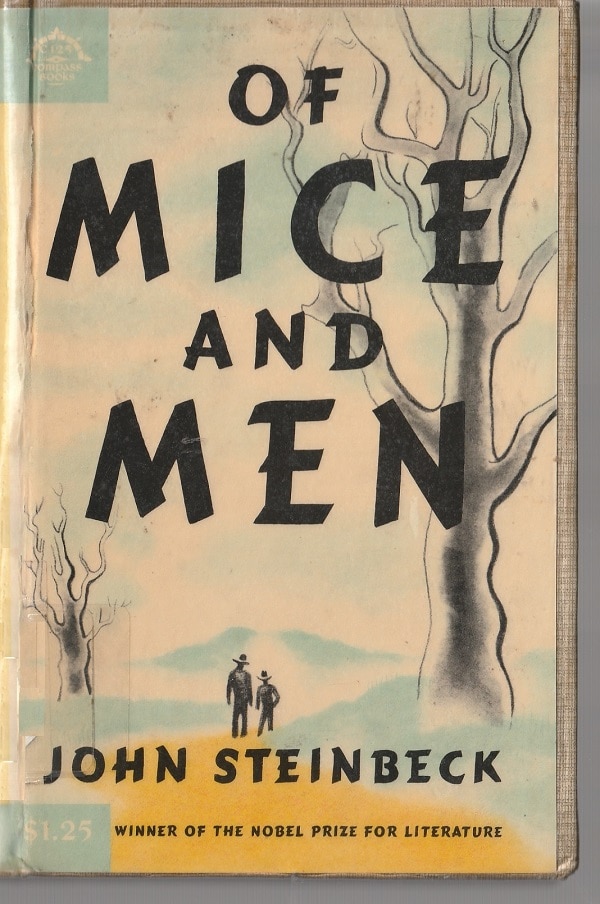
It's articulate that John Steinbeck'south 1937 novella Of Mice and Men was written to exist read as a parable. But a parable for what? I mean, what's the lesson it is pedagogy?
It's not near euthanasia. It's not about intellectual disability (what used to be called mental retardation). It'south not about doing what yous accept to do even if is painful, even though the "god-like" Slim tells George on the terminal folio:
"A guy got to sometimes."
And a few lines later:
"You hadda, George. I swear you hadda."
Yes, the volume is most all of those things. But the parable's lesson is deeper, and it has something to exercise with friendship and with dreams.
Isolated, separate, apart
The friendship that George Milton and Lennie Small have is, inside their world, extraordinary. No one else in Of Mice and Men is in a twosome.
Curly and his wife are officially in a twosome, having married, but they are each lone souls wandering through their days. Then is every other grapheme — alone.
Fifty-fifty Slim, the great hero of the ranch's landscape, is lonely. Steinbeck describes him this fashion:
He was a jerkline skinner, the prince of the ranch, capable of driving x, sixteen, even twenty mules with a single line to the leaders. He was capable of killing a fly on the wheeler's barrel with a bull whip without touching the mule.
There was a gravity in his manner and a serenity and then profound that all talk stopped when he spoke. His dominance was and then bang-up that his word was taken on any field of study, be it politics or dearest….His hatchet face was ageless. He might have been xxx-five or fifty. His ear heard more than was said to him, and his slow speech had overtones non of thought, but of understanding across thought. His hands, large and lean, were every bit fragile in their action as those of a temple dancer.
Like an Achilles or a Hercules, Slim is head and shoulders to a higher place everyone else effectually him. Yet, like everyone else except Lennie and George, he isolated, separate and apart.
His character and talents make him a champion. Yet, he doesn't own the ranch. He is, like everyone else, fastened to this land and this job equally if the ranch were a prison. Sure, he could go somewhere else, but the situation would exist the same.
He is alone the mode Curly is alone and Curly's married woman and Curly's male parent, the possessor, and Carlson, and Crooks.
"Scared of each other"
As the novel opens, Candy, the handman who lost a hand in a ranch blow, is in a kind of a twosome with his old and smelly dog.
But, possibly because of the companionship that he has that others don't have, Processed is forced past Carlson, with Slim's approving, to allow Carlson take the domestic dog out into the night and shoot it in the back of the head.
The twosome of George and Lennie is much more unsettling to those on the ranch, mysterious.
George is questioned over and again why they are together. The insinuation is that George is somehow taking reward of Lennie. Even Slim wants to know, possibly to protect Lennie. Slim says:
"Ain't many guys travel around together. I don't know why. Maybe ever'body in the whole damn world is scared of each other."
I remember that Slim's comment gets to the center of Steinbeck's parable in Of Mice and Men.
"Kinda used to each other"
Slim notes that it'due south "kinda funny a cuckoo similar him and a smart guy like you travelin' together."
George defends Lennie as "no cuckoo" and says it isn't so odd that the 2 of them travel together since "him and me was both born in Auburn. I knowed his Aunt Clara…When his Aunt Clara died, Lennie but come up along with me out workin'. Got kinda used to each other after a little while."
Information technology may look, George says, that Lennie is dumb and George is smart. But he says that, if he were smart, he'd have a identify of his own instead of working for other people. Besides, the friendship of the two men isn't i-sided. George benefits too:
"I own't got no people. I seen the guys that go effectually on the ranches alone. That ain't no good. They don't have no fun. After a long time they go mean. They go wantin' to fight all the fourth dimension."
"A hoot in hell"
George and Lennie don't go around on the ranches alone. They are a twosome. They aren't isolated, carve up, apart.
In the final pages, George, at Lennie'due south urging, tells again almost their friendship, about how "guys similar the states got no fambly…make a lilliputian stake an' then they blow it in….ain't got nobody in the worl' that gives a hoot in hell virtually 'em."
And Lennie interrupts:
"But not u.s.a.. Tell about us now."
George starts, "But not the states," and Lennie again interrupts: "Considering—" and George goes on: "Considering I got you an' —" And Lennie responds in triumph and joy:
"An' I got you. We got each other, that'due south what, that gives a hoot in hell about the states."
Considering they are a twosome
Perchance, as Slim says, everyone "in the whole damn world is scared of each other." Only not Lennie and George.
Their friendship, for all the difficulties they take with each other, is a source of fun and joy. They aren't hateful and bitter similar those who travel alone. They feel good about themselves. They experience loved.
This is one aspect of the lesson of Steinbeck'due south parable. It is through friendship — i.e., through love — that people discover themselves and feel good nearly themselves.
Yeah, George has less liberty because of Lennie and the trouble he gets into. Yes, Lennie has less freedom because George is constantly reining him in. But these irritations are simply irritations.
Considering they are a twosome, neither human feels alone, separate, apart.
"Our own"
The other aspect of Steinbeck'due south lesson is the dream that George relates with great relish and that Lennie celebrates whenever he hears it.
The dream has to do with an actual place that's up for sale:
"Well, it's x acres. Got a niggling win'factory. Got a fiddling shack on it, an' a chicken run. Got a kitchen, orchard, cherries, apples, peaches, 'cots, basics, got a few berries. They's a identify for alfalfa and plenty h2o to inundation information technology. They'a a squealer pen —"
"An' rabbits, George."
"No place for rabbits now, but I could easy build a few hutches and you could feed alfalfa to the rabbits."
Over several pages, halfway through the novel, George expands on this dream equally Lennie grows more and more than excited, finally maxim:
"An' it'd be our own, an' nobody could tin can the states."
"We got fren's"
And it'due south non but Lennie who's excited. George's own excitement is clear every time he talks most his vision. And this excitement is contagious. First, Candy and, then, Crooks, the bedridden black stablehand, want to join in with Lennie and George, captivated by the dream.
Indeed, when Curly's married woman, biting and lonely, tells them their hopes are a mirage, Processed stands up to her, telling her that they take a place to go to if she gets them fired.
"An' we got fren's, that's what we got. Maybe there was a time when we was scared of getting' canned, but we ain't no more than. Nosotros got our ain lan', and information technology's ours, an' we c'due north go to it."
It is a dream, and ane that the men aren't able to achieve considering tragedy intervenes. Yet, Steinbeck's parable is about how dreaming and friendship enrich life.
Whatever George and Lennie take to face on a day-to-24-hour interval basis is easier because they have a dream of someday finding a better life. And, even if they neglect to go far a reality — and there are many indications in Of Mice and Men that they will fail — the dream fills their days with wonder, beauty and hope.
Love and promise
Their friendship makes the dream possible. And the dream makes the friendship possible.
Processed and Crooks, hearing the dream, want to join with Lennie and George. They volition exist, Candy says, "fren'south."
The landscape described in Steinbeck's novel is hard and brutal to work. The people set in that landscape are alone, separate, autonomously.
Except for George and Lennie. Their lives are rich and vibrant because they have each other and share their dream.
Gear up in a world where "ever'body…is scared of each other," Of Mice and Men is a novel of beloved and promise. And, ultimately, tragedy.
Patrick T. Reardon
12.14.21
lankfordthimed1993.blogspot.com
Source: https://patricktreardon.com/book-review-of-mice-and-men-by-john-steinbeck/

Post a Comment for "I Need to Feel Something Again of Mice and Men"